PRODUCT RESEARCH
Read the study.
Understand the conditions.
Eight original research documents spanning pigs, broilers, dairy cows and horses. Open the study design beside each paper, then download the complete document.
Study formulations, dates and conditions differ. Historical results do not guarantee current performance or demonstrate registration in Vietnam. Use current specifications and the complete trial protocol when assessing relevance.
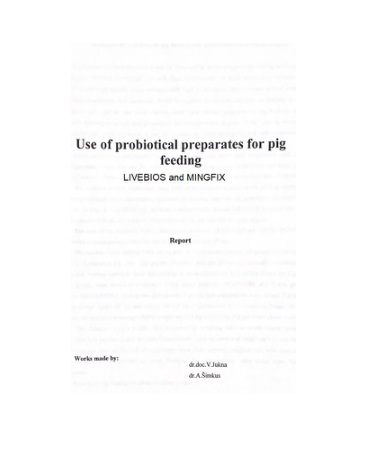
Pigs / 2002 / 5 pages
LIVEBIOS & MINGFIX in pig feeding
A Lithuanian farm report following pig growth and meat characteristics. It includes growth tables, time to reach 100 kg, carcass measurements and meat composition.
Study design & interpretation
The report describes control, LIVEBIOS and MINGFIX groups of 15 piglets each, observed from June to November 2002. It gives 2 kg/t during the first month and 1.5 kg/t subsequently, with two starting-weight cohorts. These are study rates, not current label instructions.
The author reports higher growth and changes in carcass and meat traits. The report’s descriptions of cohorts and some units are imprecise; review the full tables and protocol before calculating a commercial response.
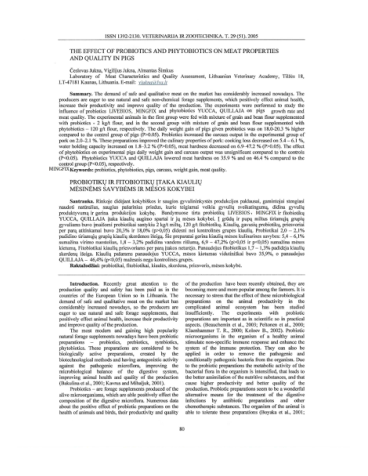
Pigs / 2005 / 4 pages
Probiotics, phytobiotics & pork quality
A published paper by Česlovas Jukna, Vigilijus Jukna and Almantas Šimkus covering LIVEBIOS and MINGFIX alongside separate Yucca and Quillaja trials.
Study design & interpretation
Fifteen animals per group, starting at 45 days. The probiotic trial used 2 kg/t and the separate phytobiotic trial 120 g/t. Diet composition, weight gain, carcass output and physicochemical meat properties are reported.
Reported daily gain was 20.3% higher for LIVEBIOS and 18.0% for MINGFIX versus control. Carcass-output differences were not statistically significant (P>0.05). Separate phytobiotic results must not be attributed to the Biofeed formulations. Results describe this historical trial, not a guaranteed farm outcome.
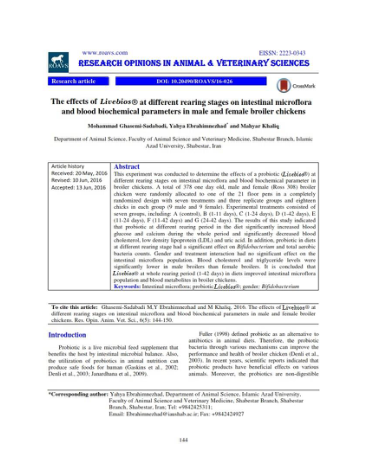
Poultry / 2016 / 7 pages
LIVEBIOS timing, intestinal microflora & blood parameters
A study in Research Opinions in Animal & Veterinary Sciences, 6(5):144–150, by Ghasemi-Sadabadi, Ebrahimnezhad and Khaliq. DOI: 10.20490/ROAVS/16-026.
Study design & interpretation
378 male and female Ross 308 chicks; seven treatments with three replicate pens of 18 birds (nine male and nine female). The study compares a control and six supplementation windows across days 1–42.
The authors report effects on intestinal Bifidobacterium, total aerobic counts and selected blood measurements, and favour whole-period supplementation in their conclusion. These endpoints do not by themselves establish disease prevention or a particular feed-conversion saving.
Dairy cows / 2008 / 11 pages
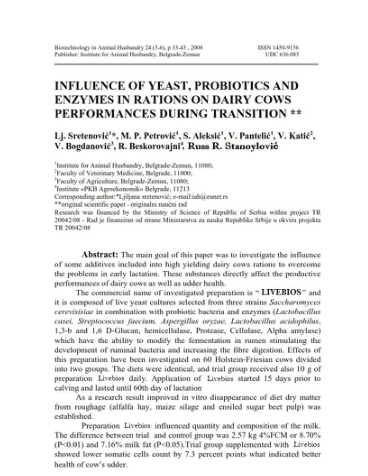
Yeast, probiotics & enzymes during dairy transition
A paper in Biotechnology in Animal Husbandry 24(5–6):33–43, led by Lj. Sretenović and co-authors, including Russ R. Stanoylovic. It covers forage digestibility, milk composition, somatic cells and blood biochemistry.
Study design & interpretation
60 Holstein-Friesian cows in two groups on identical diets. The trial group received 10 g LIVEBIOS per cow daily from 15 days before calving through day 60 of lactation. These are the historical study conditions.
Table 2 reports mean 4% fat-corrected milk of 29.55 kg for control and 32.12 kg for treatment, a 2.57 kg difference. The paper gives inconsistent percentage descriptions (8.70% in the abstract and 10.86% in the discussion). Use the table values and request clarification before reusing a percentage claim.
Poultry / 2007 / 8 pages
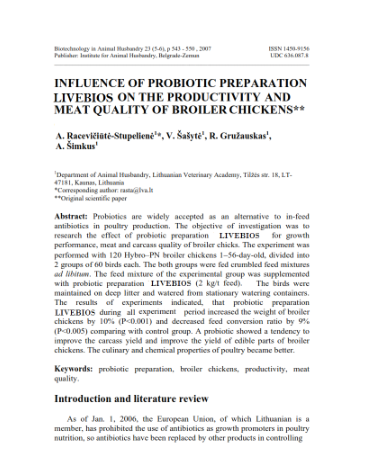
LIVEBIOS, broiler productivity & meat quality
A paper by A. Racevičiūtė-Stupelienė, V. Šašytė, R. Gružauskas and A. Šimkus in Biotechnology in Animal Husbandry 23(5–6):543–550, covering broiler growth, feed conversion, carcass yield and meat quality.
Study design & interpretation
120 Hybro-PN broilers, two groups of 60, followed from day 1 to day 56. The trial group received LIVEBIOS at 2 kg/t feed. Ten representative males per group were sampled at day 56 for carcass and meat measurements.
Table 1 reports day-56 body weights of 3,471 g versus 3,831 g and whole-period FCR of 1.78 versus 1.62 (control versus LIVEBIOS). The abstract and discussion use different body-weight percentage descriptions, so retain the raw values and study conditions when discussing the result.
Poultry / Undated report / 6 pages
BioLAC & broiler intestinal morphology
A report by Ušcebrka, Žikić, Perić, Jurcoane and Milošević on small-intestine length, villus height, crypt depth and villus-to-crypt ratios.
Study design & interpretation
Ross 308 chicks in two treatment groups, each with four pens of 75 birds, on a corn/soybean diet to day 42. BioLAC was used at 1 kg/t. Eight birds per group were sampled for intestinal measurements, with at least 15 measurements per parameter per bird.
The report finds significant differences in several morphology measures. These are tissue-level endpoints; they should not be converted directly into a guaranteed FCR or disease-prevention claim.
Poultry / 2004 / 5 pages
MINGFIX in broiler feed: VNITIP report
A Russian trial report organised by Russ Stanoylovic, with VNITIP study management by T. M. Okolelova. The report includes feed recipes and 42-day broiler results.
Study design & interpretation
Two groups of 35 birds. Control birds received a non-toxic basal feed; the trial group received feed described as slightly toxic with MINGFIX at 2 kg/t in the first growth period and 1 kg/t in the second.
Reported FCR was 1.85 for control and 1.76 for the trial group; day-42 weight was 2,477.4 g and 2,529.2 g respectively. Because feed quality and supplementation both differed, this comparison does not isolate the effect of MINGFIX alone. The report does not establish a current dose for Vietnam.
Equine / Undated article / 2 pages
A natural way to equine health with LIVEBIOS
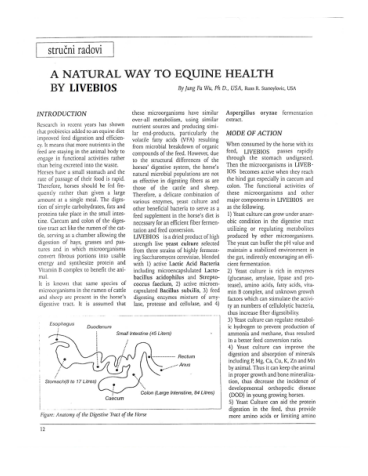
An article by Jung Fu Wu and Russ R. Stanoylovic describing equine digestion, yeast culture, bacteria, enzymes, mineral availability and a nutrient-digestibility comparison.
Study design & interpretation
A table for yearling horses compares control versus control plus LIVEBIOS: dry matter 70.2% versus 76.6%; acid-detergent fibre 59.5% versus 67.8%; neutral-detergent fibre 55.8% versus 69.5%; hemicellulose 53.5% versus 65.1%; total nitrogen 52.9% versus 55.3%.
The two-page article does not provide a full sample-size, dose or statistical protocol beside the table. Treat it as a historical technical discussion and request the underlying trial before estimating a response.
THE NEXT STEP
Discuss a trial on your farm.
Tell us your species, ration and target. Request the research and technical guidance that match your feeding programme.